
The Reserve Bank of India has kept the key short term lending rate (repo rate) unchanged at 7.25%.

Apple's newest phone iPhone 14 will be made in India as the global tech titan bets big on the manufacturing prowess of the world's second-biggest smartphone market after China.

The ongoing key reforms such as sops for manufacturing, easier labour laws, wooing FDI inflows and privatisation will help improve productivity and support long-term growth at 7.5-8 per cent levels, which if played out well, can help India contribute 15 per cent of global GDP growth by FY2026, says a report. According to a report pencilled by the India economist at UBS Securities, Tanvee Gupta Jain, the country has the lowest manufacturing costs among peers, even though China retains significant ecosystem advantages and despite that India and Vietnam appear most likely to benefit from a shift out of China.
.jpg)
The subdued labour market is likely to recover.

Macroeconomic data announcements, global trends and trading activity of foreign investors would guide momentum in the equity market this week, analysts said. Markets ended a five-week losing streak and gained nearly a per cent last week, helped by a sharp rebound on Friday. Last week, the BSE benchmark jumped 500.65 points or 0.77 per cent and the Nifty gained 169.5 points or 0.87 per cent.

The government on Thursday tweaked curbs on imports of laptops and computers as it allowed importers to bring in shipments of IT hardware from overseas on a mere 'authorisation' upon detailing quantity and value. The new 'import management system' is aimed at monitoring shipments of laptops, tablets and computers into the country without hurting market supply or creating a cumbersome licensing regime. The announcement is likely to provide relief to companies in the IT hardware segment in India as they had flagged concerns over the imposition of a strict licensing regime for importers.

Efforts should be made to nurture the talent and make sure that the skill development programme matches the growth requirement of the industry, the former Finance Minister said.

Home-grown companies, including electronics manufacturing services (EMS) firm Dixon Technologies and mobile device maker Lava International, have started exploratory talks with Chinese sub-assemblies and component players for setting up joint ventures (JVs) in the country. Sources in the industry say many domestic companies have also had preliminary discussions with original design manufacturers (ODMs) in China to look at a JV model for manufacturing smartphones. Key ODM players in mobile devices in China include Longcheer, Huaqin, and Wingtech, which has already set up a plant in Tirupati.


'Investors should ideally consider equity allocations from a medium-to-long term perspective.'

... while learning from past tech revolutions, suggests Ajit Balakrishnan.

The Union government is likely to come out with a liberalised foreign direct investment policy in a bid to make foreign investment an engine of growth and create large-scale employment.

The new policy would also allow many of the stuck programmes, like the heavy weight torpedos for the six Scorpene submarines, to move ahead with clarity.

Global funds, according to Christopher Wood, global head of equity strategy at Jefferies, are now beginning to pay more attention to India with the market now offering 30 companies with a market capitalisation over $25 billion.
The manufacturing capacity for the influenza vaccines is inadequate for a world of 6.8 billion people, nearly all of whom are susceptible to infection by the new H1N1 virus, a top official of the World Health Organisation said on Wednesday.

'India is an equity market with a breadth and depth of companies to invest in.'

Chief Economic Advisor V Anantha Nageswaran on Thursday said the economy is expected to grow at 6.5 per cent in the current fiscal notwithstanding deficient rains in August. India recorded economic growth of 7.8 per cent in the April-June quarter of 2023-24 against 13.1 per cent in the year-ago period. India's economy in Q1 grew at the fastest pace in a year, on the shoulders of a boost in capital expenditure both at central and state levels, along with stronger consumption demand, especially in rural areas, and improved performance in the services sector, he said.

The minister said this underlying resentment and pain of those countries regarding the global economy was building up for the last 15-20 years and the COVID-19 pandemic and the Ukraine conflict resulted in prices of energy and food items going up.

India on Wednesday voted in favour of a draft resolution tabled in the UN Human Rights Council that condemns and strongly rejects recent "public and premeditated" acts of desecration of the Quran.

EAM Jaishankar's mission is aimed at strengthening India's strategic autonomy in a complex international environment, observes Ambassador M K Bhadrakumar.

'Although mid- and small-cap funds have the potential for higher growth, they come with inherent higher volatility.'

The Home Ministry had asked the department of telecommunication to ensure access to all encrypted data, including that of international players such as Blackberry, Skype and even Gmail.
Regretting absence of a comprehensive national policy for IT hardware manufacturing industry, a Parliamentary panel has recommended "urgent" finalisation of such a policy in order to fully exploit its vast potential.

'We are going to have hybrid cars, which, as far as I know, none of our competition is working on, and this includes ethanol.'

India and the US on Friday said they have started talks to put in place a strategic framework for human space flight by year-end as they plan to send an Indian astronaut to the International Space Station in 2024.
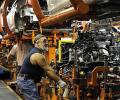
Regarding employment, the manufacturing sector hiring remained broadly unchanged.
India needs to create 220 million jobs in the next 15 years and this is only possible by implementing the National Manufacturing Policy, launched recently by the government, says Arindam Bhattacharya, managing director, The Boston Consulting Group (BCG) India Pvt Ltd.
WPI-based inflation falls to 5-month low of 6.16%.

The foremost lesson is that technology has got commoditised.
 © 2026 Rediff.com - Advertise with us - Disclaimer - Privacy Policy - Sitemap - Feedback - About us - Terms of use - Grievances